The Scoreboard Marriage: Why Keeping Track Is Killing Connection
/There is a moment in many marriages when the relationship quietly shifts from feeling like a partnership into feeling like a performance review. It rarely happens all at once. Most couples do not notice the change immediately because it sneaks in slowly through stress, exhaustion, resentment, disappointment, and unmet expectations. One day, two people who once laughed over late-night tacos and stayed up talking for hours suddenly find themselves mentally documenting every chore, every sacrifice, every inconvenience, and every perceived imbalance in the relationship.
The conversations start sounding less like intimacy and more like accounting. “I did dishes three times this week.” “I worked all day.” “I always initiate affection.” “You never notice what I do around here.” “I took care of the kids while you relaxed.” “I paid the bills.” “I cooked dinner.” “I folded the laundry.” What begins as an attempt to feel understood slowly transforms into a competition over who is more exhausted, more neglected, more responsible, or more unappreciated. Somewhere along the way, the marriage becomes a scoreboard instead of a connection.
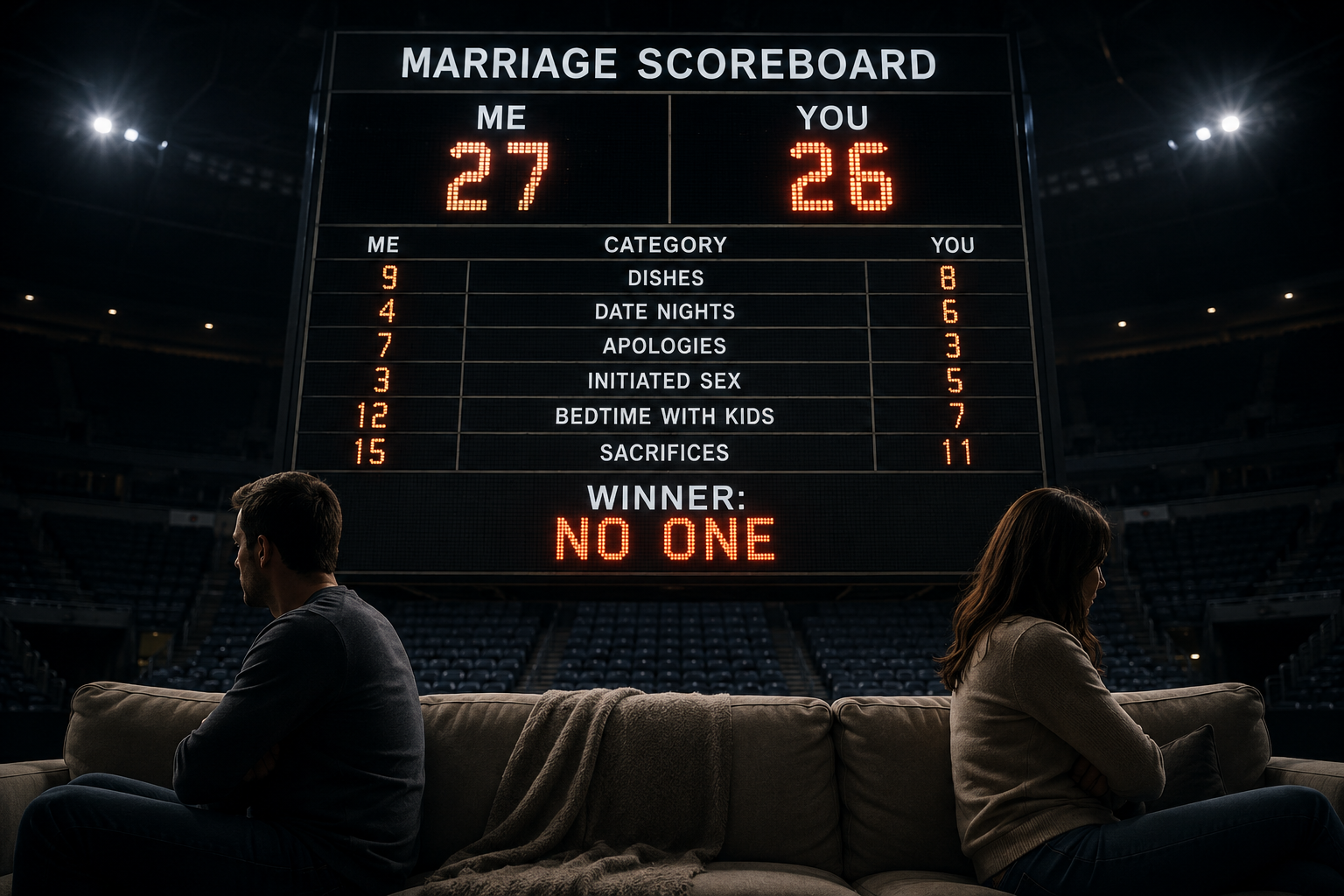
Marriage scoreboard with no winner
The problem is that most couples are not actually fighting about dishes, laundry, schedules, or household responsibilities. Those things matter, of course, but they are usually symbols of something deeper happening underneath the surface. Most scoreboard marriages are rooted in the painful feeling of not being seen, valued, appreciated, desired, or emotionally supported. The dishes are rarely just dishes. They become evidence in a much larger emotional trial taking place inside the relationship.
When emotional connection weakens, people naturally start searching for proof that they matter. Human beings want to know that their efforts count, their sacrifices are noticed, and their presence is meaningful to the people they love most. When that reassurance is absent for too long, resentment begins filling in the blanks. Eventually, couples stop looking at each other through the lens of grace and start looking at each other through the lens of fairness. Unfortunately, fairness can become incredibly dangerous when it becomes the primary operating system of a marriage.
Healthy marriages are not built on perfect equality every single day. Real relationships are fluid because real life is fluid. Some weeks, one partner carries more emotional weight. Other weeks, one person handles more responsibilities because the other is overwhelmed, sick, stressed, grieving, burned out, or emotionally drained. Marriage was never meant to function like a constant 50-50 transaction. The strongest couples understand that partnership often means taking turns carrying each other through different seasons of life.
The scoreboard mentality changes the emotional atmosphere of a relationship almost immediately. Instead of viewing each other as teammates, couples begin seeing each other as opponents. Every interaction becomes subconsciously evaluated. Every act of service becomes measured. Every sacrifice becomes documented. Rather than giving freely out of love, people begin giving conditionally while secretly waiting to see if their efforts will be reciprocated at the exact same level. That is exhausting.
It is emotionally draining to constantly monitor who has done more, who initiated last, who apologized first, who planned the date night, who got less sleep, or who made the greater sacrifice that week. Marriages cannot thrive when both people are functioning like emotional accountants. Intimacy requires generosity, but scorekeeping creates defensiveness. Connection requires vulnerability, but scorekeeping creates guardedness. Love flourishes in environments of safety and appreciation, not in environments where every action is being evaluated for fairness and balance.
One of the most common phrases I hear in couples counseling is, “I just want to feel appreciated.” Underneath the anger, frustration, criticism, and resentment, there is often a very wounded person longing to feel emotionally valued again. The husband talking about how much he works may not actually need applause for going to the office. He may need reassurance that his efforts matter to his spouse. The wife bringing up the endless household responsibilities may not simply want recognition for laundry and dishes. She may desperately want someone to notice how mentally and emotionally overloaded she feels every single day.
The danger is that when appreciation disappears, resentment takes its place. Resentment rarely explodes overnight. It grows slowly and quietly through repeated moments of disappointment that never get repaired. Small hurts begin stacking on top of each other like emotional bricks. One partner starts believing they care more. The other starts believing nothing they do is ever enough. Eventually, both people feel misunderstood while simultaneously misunderstanding each other.
What makes scoreboard marriages especially destructive is that both people often believe they are the more loving partner. Both individuals can produce a detailed list of sacrifices, frustrations, and examples supporting their case. Each person becomes deeply aware of their own contributions while becoming increasingly blind to the contributions of the other person. This is not usually because either spouse is malicious. It is because pain narrows perspective. When people feel emotionally deprived, they naturally focus more on what they are not receiving rather than what the other person may already be giving.
Social media certainly does not help this dynamic. Everywhere couples look, they are bombarded with unrealistic messages about relationships. People post curated examples of romance, emotional attentiveness, expensive vacations, elaborate gifts, and seemingly effortless connections. Meanwhile, real couples are trying to survive soccer practice, bills, exhaustion, work stress, sick kids, anxiety, overstimulation, and arguments about why someone left an empty milk carton in the refrigerator like a tiny act of domestic terrorism.
Comparison fuels resentment because it creates impossible standards. Suddenly, ordinary acts of partnership stop feeling meaningful because they are overshadowed by unrealistic expectations of what love is supposed to look like. Instead of appreciating each other’s efforts, couples begin evaluating whether those efforts measure up to some imaginary ideal they have created in their minds. The result is two disappointed people who are often far more loved than they realize.
Another issue with scoreboard marriages is that they slowly poison affection. It is difficult to feel emotionally close to someone you constantly resent. It is hard to desire someone who feels more like a demanding coworker than a safe emotional companion. Over time, conversations become increasingly transactional. Affection decreases. Gratitude disappears. Playfulness fades. Couples stop assuming the best about each other and begin assuming the worst.
A husband forgets to take out the trash, and it no longer feels like forgetfulness. It feels disrespectful. A wife falls asleep before intimacy, and it no longer feels like exhaustion. It feels rejection. Small moments become loaded with emotional meaning because unresolved resentment changes the interpretation of everything. The marriage slowly shifts from connection to calculation.
The irony is that keeping score almost never creates the outcome people are hoping for. Most people believe that if they can finally prove how much they do, their partner will suddenly understand, validate them, and change. Sometimes that happens briefly, but more often, scorekeeping creates defensiveness instead of empathy. Nobody responds well to constantly feeling evaluated or criticized. Human beings tend to move toward environments where they feel appreciated and emotionally safe, not environments where they constantly feel like they are failing.
This is why appreciation matters so deeply in relationships. Appreciation softens defensiveness and restores emotional goodwill. When people feel seen, they become more emotionally available. When people feel valued, they naturally become more generous. Gratitude changes the emotional climate of a marriage because it reminds couples that they are allies instead of adversaries.
One of the healthiest questions couples can ask themselves is not, “Is everything perfectly equal?” but rather, “Are we caring for each other well right now?” Those are very different questions. One focuses on mathematical fairness while the other focuses on emotional connection. Strong marriages are not built by two people obsessively measuring equal contribution every moment of every day. They are built by two imperfect people repeatedly choosing generosity, empathy, repair, humility, and grace.
That does not mean imbalance should never be addressed. There are absolutely situations where one partner is carrying an unhealthy amount of emotional, physical, or mental labor. Those conversations matter and should be discussed honestly. However, there is a major difference between addressing imbalance with vulnerability versus attacking each other with accumulated evidence. One approach invites teamwork while the other invites defensiveness.
The healthiest couples learn how to communicate needs before resentment hardens into bitterness. Instead of saying, “You never help me,” they learn to say, “I am overwhelmed, and I need support.” Instead of saying, “I always initiate intimacy,” they learn to say, “I miss feeling desired and connected to you.” Instead of saying, “You never notice what I do,” they learn to say, “I think I have been craving appreciation lately.” Vulnerability creates opportunities for connection that criticism rarely accomplishes.
Marriage becomes dangerous when couples stop interpreting each other through love and start interpreting each other through suspicion. The scoreboard mindset trains people to look for failures instead of efforts. It creates an emotional environment where nobody feels fully safe because both individuals are busy defending their own value. Over time, even good intentions become difficult to recognize because resentment acts like a filter over the relationship.
At the core of every healthy marriage is the understanding that love is not merely transactional. Real love cannot survive if every act of kindness comes with an invisible invoice attached to it. Relationships thrive when both people occasionally give more than they receive without turning those sacrifices into future ammunition. The goal of marriage is not to win the fairness competition. The goal is to build a relationship where both people feel emotionally secure, deeply valued, and consistently connected.
The truth is that every marriage will experience seasons where things feel uneven. Someone will get sick. Someone will burn out. Someone will struggle emotionally. Someone will need more support than they can currently give. Strong couples survive these seasons because they understand they are on the same team. They stop asking, “Who is doing more?” and start asking, “How do we get through this together?” That shift changes everything.
Because marriages do not usually collapse from one major moment. They often erode through thousands of tiny moments where appreciation disappears, resentment grows, and connection slowly gets replaced by calculation. The scoreboard feels productive in the moment because it gives pain somewhere to go. But eventually, all it really does is create two lonely people standing on opposite sides of the relationship, trying desperately to prove they deserve to be loved. And the saddest part is that most of the time, both of them already are.